Vishal Kumar Jaiswal
Postdoctoral Researcher @ University of Bologna
Ultrafast photochemistry, Classical and Quantum dynamics, Computational Spectroscopy

Research
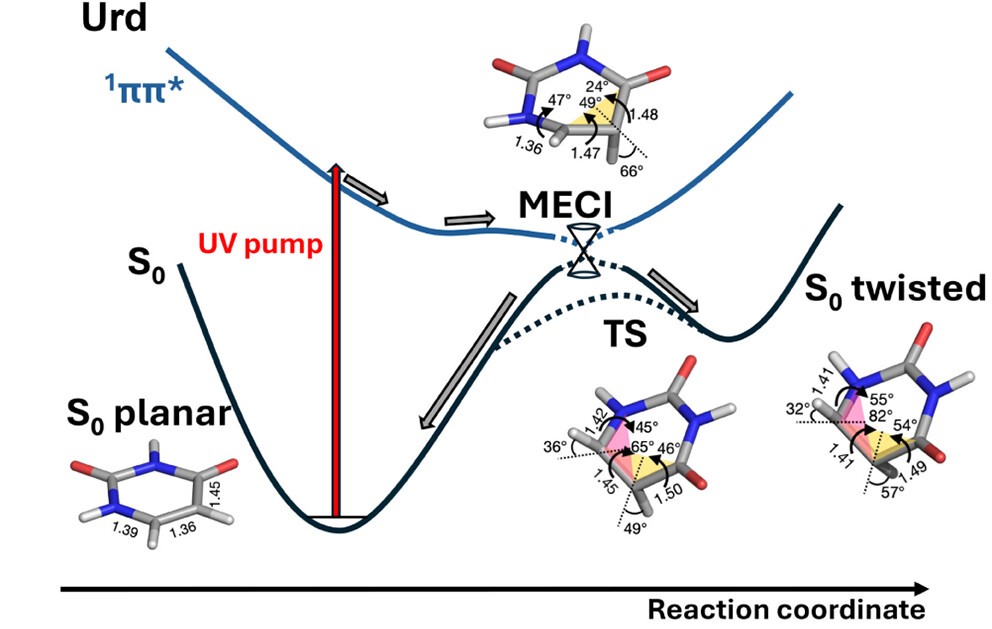
A Twist in Electronic Relaxation of Pyrimidine Nucleosides and Nucleotides: Impact of C5 Methylation on Nonadiabatic Transition and Photohydration Damage
Srijon Ghosh, Yuki Obara, , Mario Taddei, Artur Nenov, Irene Conti, Marco Garavelli, Toshinori Suzuki
Journal of the American Chemical Society, 2026
The Digest: We unraveled the mechanism behind UV-induced DNA damage via a ground-state twisted intermediate (TI). My detailed QM/MM surface-hopping simulations tracked molecular trajectories, showing that efficient TI formation relies on ballistic motion and momentum transfer at the excited-state crossing. I computationally demonstrated that C5-methylation hinders this momentum, shifting the system from a "dynamical-control" to a "static-control" regime and drastically reducing damage.
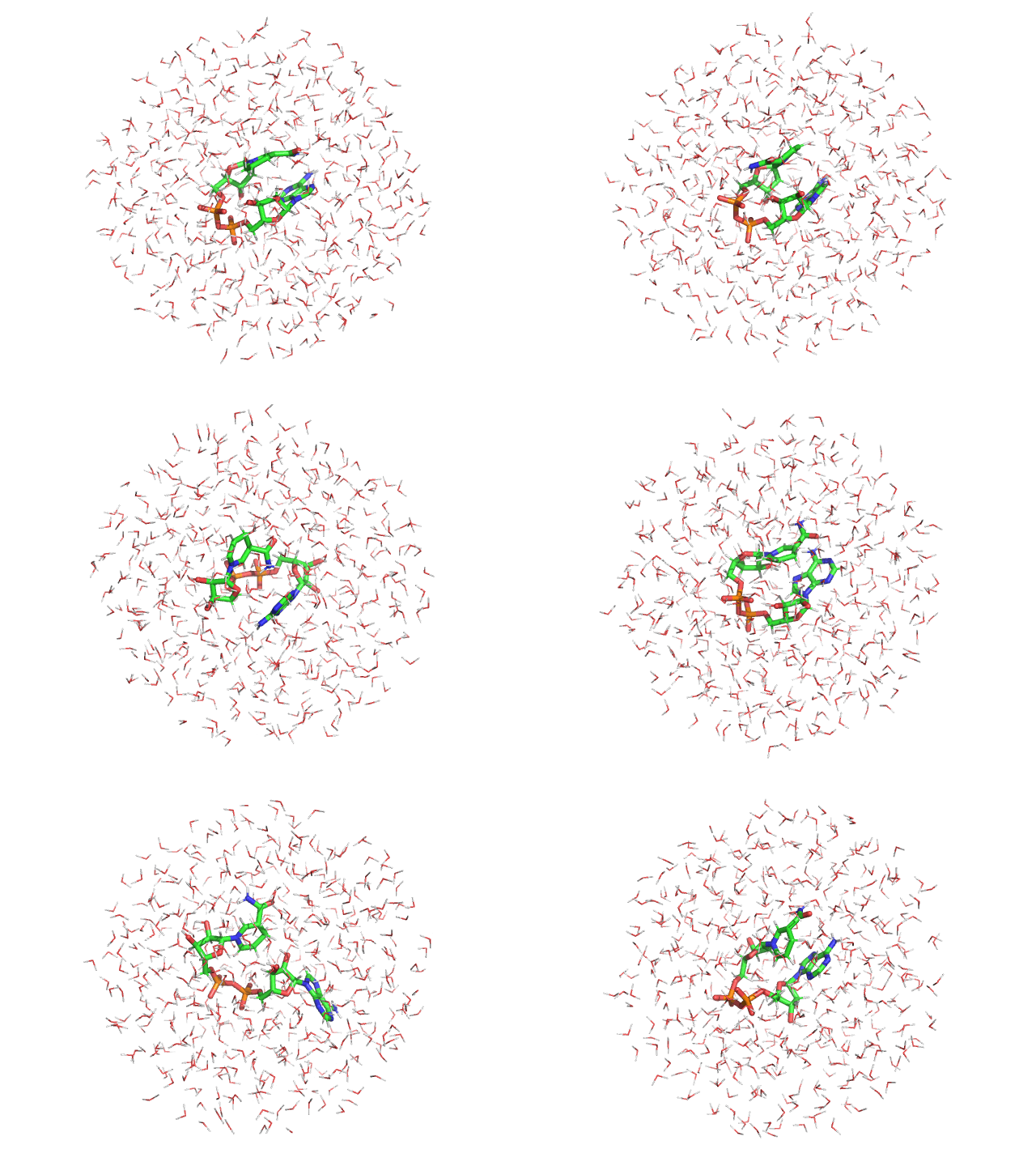
Sub-100-fs energy transfer in coenzyme NADH is a coherent process assisted by a charge-transfer state
, Daniel Aranda Ruiz, Vasilis Petropoulos, Piotr Kabaciński, Francesco Montorsi, Lorenzo Uboldi, Simone Ugolini, Shaul Mukamel, Giulio Cerullo, Marco Garavelli, Fabrizio Santoro & Artur Nenov
The Digest: Energy-transfer occurs in NADH coenzyme in the order of 50fs upon excitation of adenine moiety. Large-scale quantum dynamics were performed on variety of conformers to map out the coherent pathway leading to this ultrafast phenomena. Replica-Exchange MD was used to map out the conformational space of the flexible molecule. High-level multireference CASPT2 based methods were used to parametrize the potential energy surface on which quantum-dynamics were performed with the ML-MCTDH protocol.
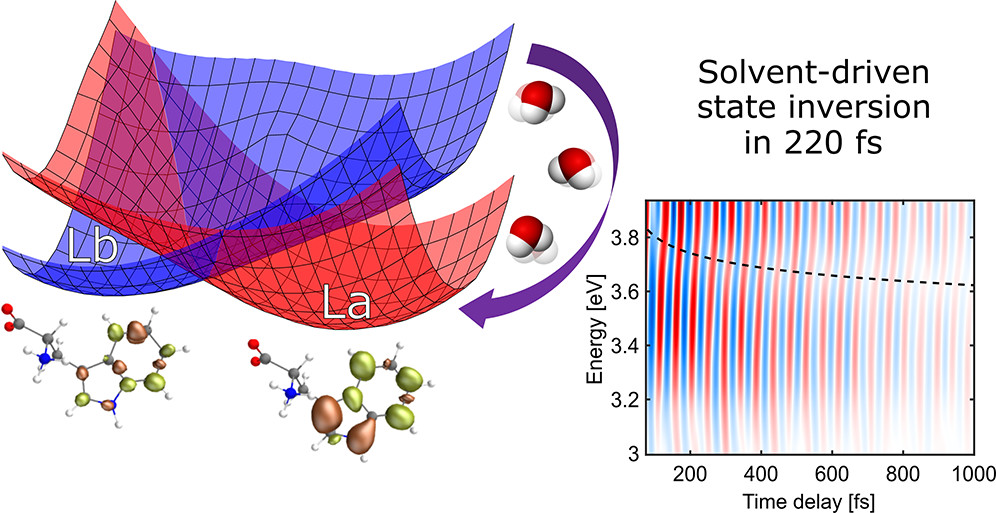
Environment-Driven Coherent Population Transfer Governs the Ultrafast Photophysics of Tryptophan
, Piotr Kabaciński, Barbara E. Nogueira de Faria, Marziogiuseppe Gentile, Ana Maria de Paula, Rocio Borrego-Varillas, Artur Nenov, Irene Conti, Giulio Cerullo, and Marco Garavelli
Journal of the American Chemical Society, 2022
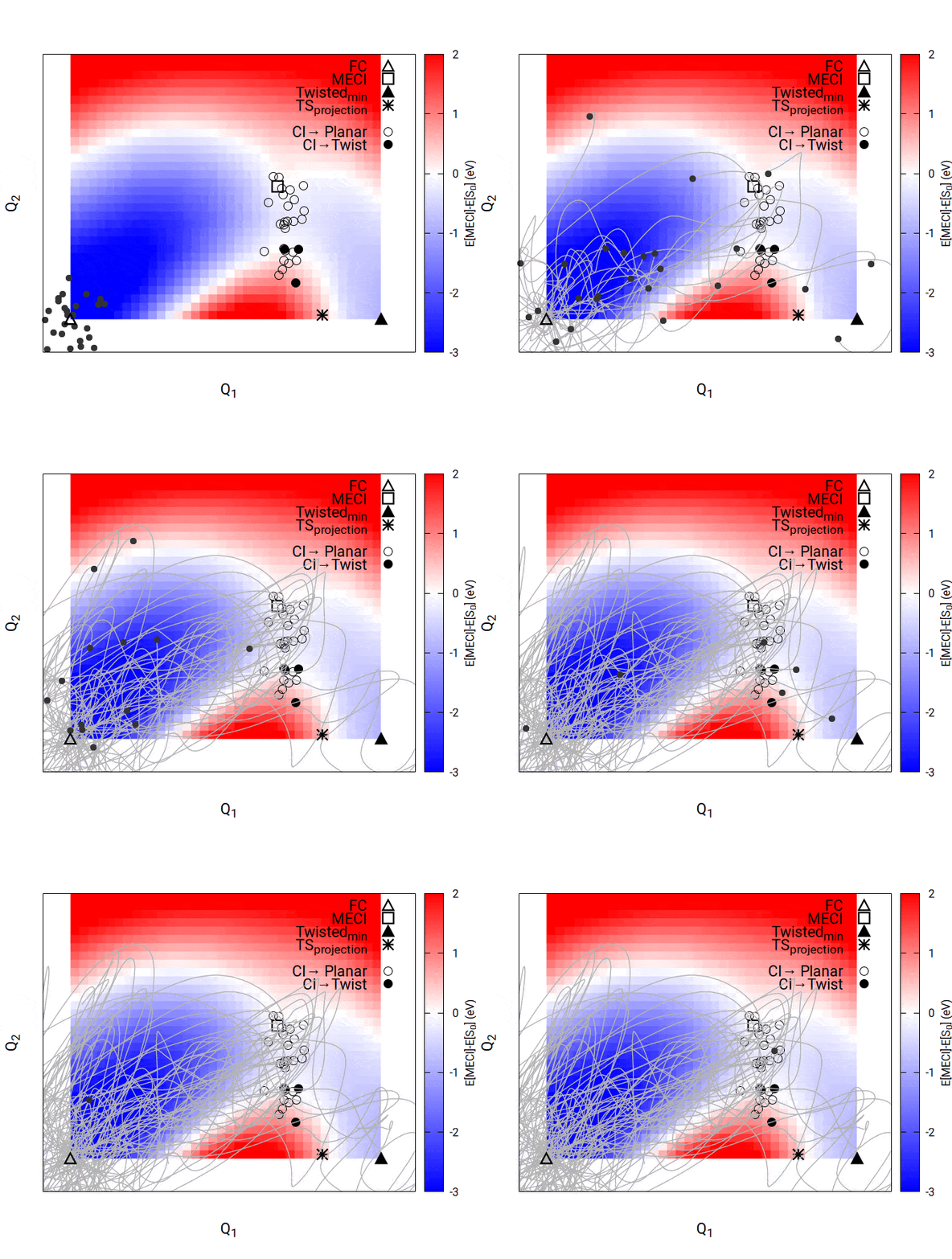
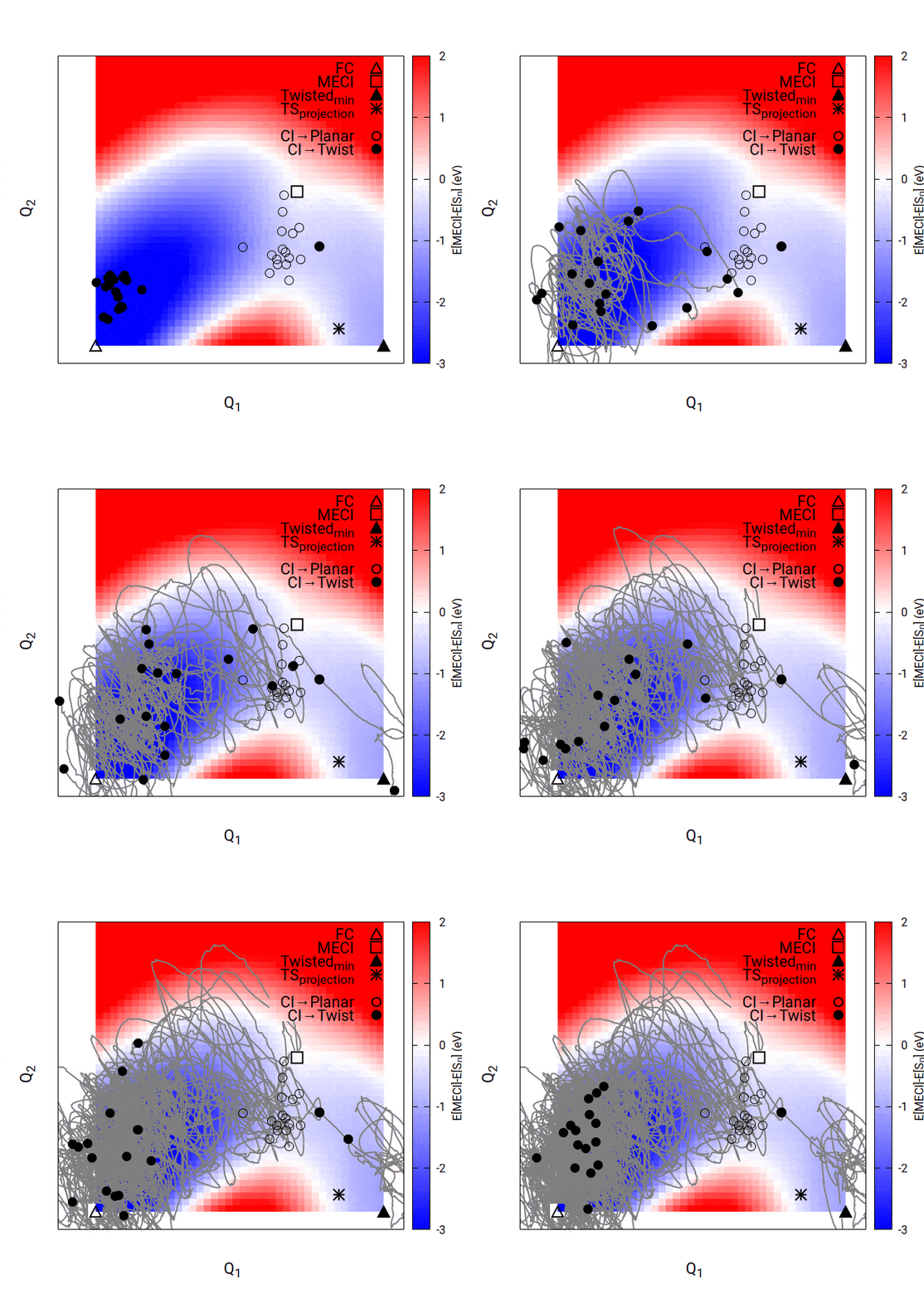
The Digest: The photoinduced response of aqueous tryptophan involves the lowest two excited states of the molecule and the dynamic response of polar solvent. The branching-space potential energy surfaces and the solvent response was mapped out by using QM/MM techniques complementing high-level electronic structure theory at CASPT2 level. This detailed computational protocol elucidates how the coherent excitation is transferred from the Lb to the La state through a conical intersection assisted by the dynamic solvent response to the electronic distribution of the photo-excited solute.
Reconciling TD-DFT and CASPT2 electronic structure methods for describing the photophysics of DNA
, Mario Taddei, Daniel R. Nascimento, Marco Garavelli, Irene Conti, Artur Nenov
Photochemistry and Photobiology, 2024
The Digest: This work addresses a long-standing friction point in computational photochemistry: why do two of our most popular tools, TD-DFT and CASPT2, often predict different results for DNA photophysics? Using aqueous uridine as a benchmark, we show that the underlying "geography" (topology) of the potential energy surfaces is actually remarkably consistent between both methods. The discrepancies seen in dynamics are not due to fundamental failures, but rather to subtle differences in how each method describes the "crossing points" (conical intersections) and the surrounding solvent environment.
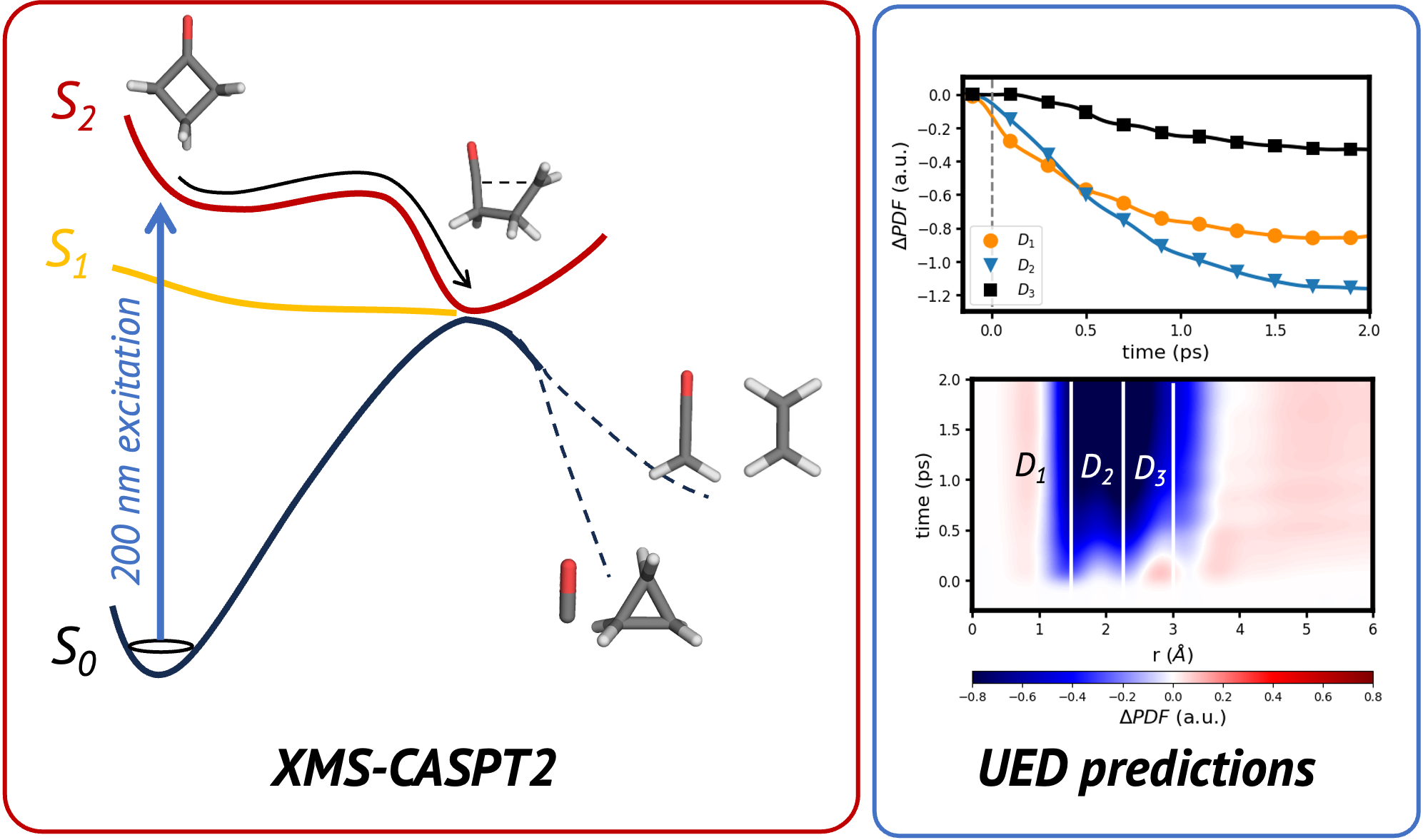
Ultrafast photochemistry and electron-diffraction spectra in n → (3s) Rydberg excited cyclobutanone resolved at the multireference perturbative level
, F. Montorsi, F. Aleotti, F. Segatta, Daniel Keefer, Shaul Mukamel, A. Nenov, I. Conti, M. Garavelli
The Journal of Chemical Physics, 2024
The Digest: This research provides a theoretical foundation for interpreting ultrafast structural measurements of molecules undergoing complex dissociation. We focused on the n→3s Rydberg excitation of cyclobutanone, a system where multiple chemical pathways compete on a sub-picosecond timescale. By employing XMS-CASPT2 gradients within a trajectory surface hopping framework, we tracked the molecular wavepacket as it relaxed from Rydberg to valence states. A key component of this work was the direct simulation of Time-Resolved Gas-Phase Electron Diffraction signals. We successfully identified the structural fingerprints of ring-opening and decarbonylation, demonstrating that multireference perturbative theory is essential for accurately resolving the transient diffraction patterns observed in ultrafast experiments.